The Zen of the Vanishing Murderer
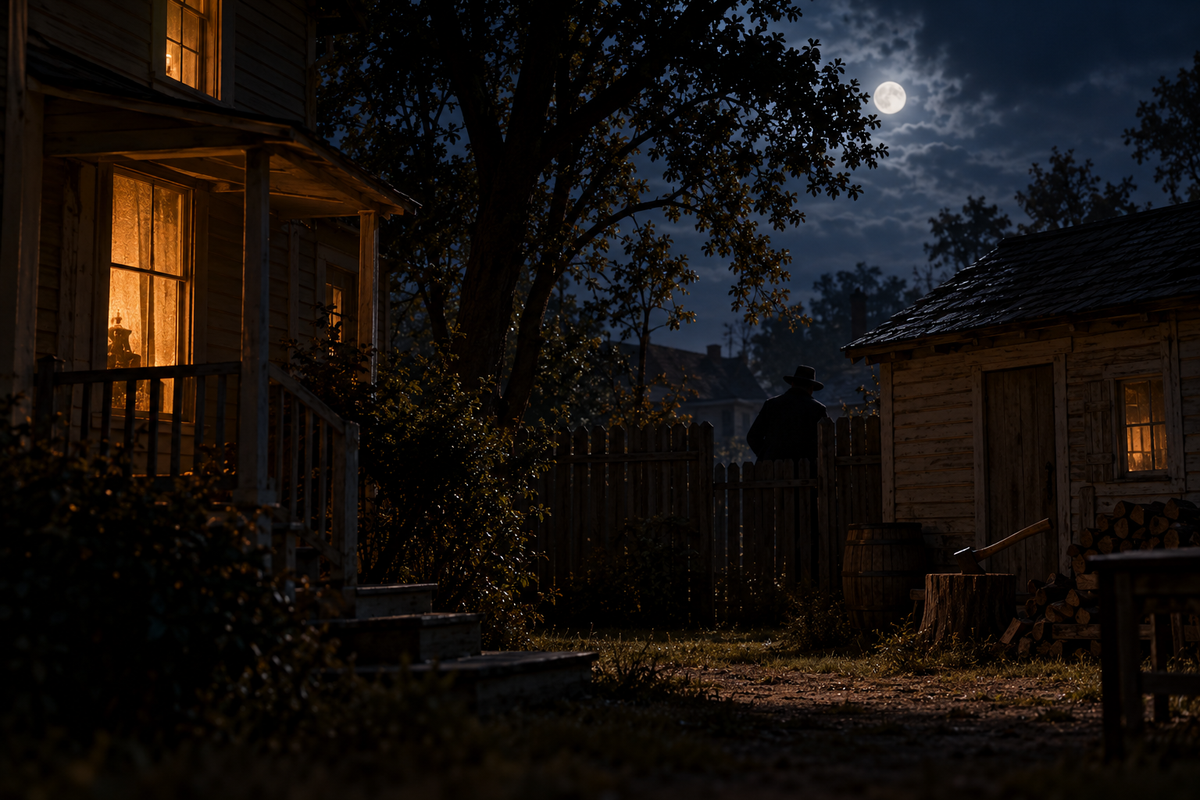
Why Austin Couldn't Find the Servant Girl Annihilator
The Koan of the Vanishing Murderer
A student asked the master, “How does a murderer vanish from a city where everyone is searching for him?”
The master replied, “First, tell me where they were looking.”
“In the streets, in the shadows, among strangers. They searched everywhere.”
“And what did they find?”
“Many suspects, many rumors, and no murderer.”
The master extinguished his lamp.
“Tell me what you can see.”
“Nothing,” said the student.
“And yet,” replied the master, “the room has not changed.”
In 1885, Austin, Texas, was a small but growing state capital, its streets shared by horse-drawn wagons, pedestrians, and newcomers arriving by rail. Yet beneath the bustle of everyday life, fear was spreading. Beginning in late 1884, a series of brutal nighttime attacks had claimed the lives of several residents, primarily Black women employed as domestic servants. The newspapers gave the unknown killer a chilling name: the Servant Girl Annihilator.
More than 140 years later, the murders remain unsolved. But before asking why Austin failed to catch the killer, we need to leave our 2026 assumptions behind. The mystery can only be understood by examining the city as it actually existed in 1885—and what its people could reasonably have known.
A Murderer in the Texas Capital
The first widely recognized attack occurred in the final days of 1884.
Mollie Smith, a young Black domestic worker, was killed during the night. Walter Spencer, who was sleeping nearby, was severely injured but survived.
The attack was brutal, intimate, and bewildering. Someone had entered a place where people were sleeping, assaulted them, and disappeared before anyone could identify him.
More attacks followed.
Women were killed in their homes or sleeping quarters. Some victims were dragged outside. Blunt instruments and sharp weapons figured in the violence. The circumstances were sufficiently similar to suggest a connection, yet different enough to leave room for doubt.
As the attacks accumulated, Austin's newspapers reported an increasingly frightened city. Rumors flourished. Suspects were questioned. The authorities searched for explanations.
By Christmas Eve 1885, the terror would reach a climax.
But to understand why the murderer remained unidentified, we must first understand the city in which he operated.
A City That Wasn't Quite a Small Town
Austin had 11,013 residents at the 1880 census. By 1885, the city was undergoing further changes, with Capitol construction, commercial activity, and rail connections bringing workers and visitors into its streets.
It was the capital of Texas, a center of government, commerce, construction, and transportation. The enormous new Capitol was rising above the city. Rail connections made it easier for people to arrive, depart, and move between communities.
This was not an isolated village where every face was familiar.
Austin was large enough to contain strangers, temporary workers, newcomers, and people whose movements attracted little attention. Yet it remained small enough that residents might imagine a dangerous stranger would be easy to recognize.
That combination could be deceptive.
A man walking through a neighborhood after dark might be a laborer returning from work, a visitor, a resident of another part of town, or someone with entirely legitimate business nearby.
Even if a witness remembered seeing him, what would make that particular man suspicious?
A stranger is only useful to an investigation if someone knows that he matters.
And in a growing city, there were plenty of strangers.
A City of Many Communities
Austin's population was not only changing. It was remarkably varied for a city of its size.
According to the 1880 census, 3,587 of Austin's 11,013 residents were Black—nearly one-third of the population. The city also had established German and Mexican communities, along with immigrants from Ireland, Sweden, and other parts of Europe.
The new Texas Capitol added another dimension. Its construction attracted workers from elsewhere in Texas and beyond. One particularly curious episode involved 88 Scottish stonemasons recruited to work on the project after a labor dispute. Not all reached Texas, but the episode illustrates just how far the city's labor connections extended.
Austin was also home to men who had fought in the Civil War, which had ended only twenty years earlier. Confederate veterans were part of the city's everyday life, working, raising families, conducting business, and participating in civic affairs. The war was not distant history to these men. It was part of their own lives, and its aftermath remained part of the world in which Austin's residents lived.
All these people occupied the same relatively small geographical space.
But occupying the same city is not the same thing as belonging to the same social world.
People worked together, traded with one another, and encountered one another in the streets. Yet their closest relationships, neighborhoods, churches, languages, and informal networks could be quite different. Race, class, occupation, national origin, and personal history all influenced those connections.
A German immigrant might be well known within one community and almost entirely unknown outside it. A Scottish stonemason might spend his days among fellow construction workers while having little contact with the households in which domestic servants worked. Black residents might possess extensive knowledge of their own neighborhoods that circulated only imperfectly through the city's other social networks.
These were not sealed communities. Their boundaries were crossed every day. But the connections were uneven, and some were much stronger than others.
That distinction matters enormously in a murder investigation.
Suppose someone noticed an unfamiliar man near a house late at night. Who would hear about it? His neighbors? His employer? The police? And if a similar observation was made across town, in a different community, who would recognize the possible connection?
Austin had no shortage of people who might have noticed something.
What it lacked was a reliable way to bring all those observations together.
A city of eleven thousand people might sound like a place where everybody knew everybody.
But Austin contained many different worlds, and a man could be familiar in one while remaining a stranger in another.
He did not necessarily have to leave the city to disappear.
He might only have had to cross a social boundary.
Eleven Policemen and a Growing Panic
Austin's police force was small—contemporary accounts and later histories suggest roughly eleven officers during this period.
Those men were responsible for ordinary policing as well as an extraordinary series of murders. They could patrol streets, question residents, pursue suspects, and respond to disturbances. They could not watch every alley, yard, household, and road.
There was also the problem of finding a policeman when one was needed.
Contemporary newspaper reporting indicated that only four officers were on duty at any given time. Four officers for a growing city, responsible for whatever happened during their watch.
And there was no modern communications system to help them.
Austin did have telephones, but they were still something of a novelty. In June 1881, just seventeen businesses had working telephones. By August 1883, the city had 125 subscribers. The network was expanding, but telephone access remained limited.
If someone heard screams in the night or discovered an injured neighbor, summoning help might mean running to find an officer or sending someone to the police station.
And where was the nearest officer?
Even if someone managed to find one, that officer had no radio, patrol car, or immediate means of contacting his colleagues. Information had to travel from person to person, and organizing a response took time.
By the time the police learned that an attack had occurred, the attacker might already have disappeared.
The problem was not simply how many policemen Austin employed.
It was how few could be reached when something happened—and how difficult it was to bring them together.
Nor did the city simply sit helplessly while the killings continued.
Additional police manpower was brought in. Private detectives, including Pinkerton operatives, were employed. Bloodhounds were used in attempts to follow trails.
These were serious efforts by the standards of the time.
They also reveal the limits of those standards.
A bloodhound might follow a scent from a crime scene, but the trail could be interrupted by traffic, weather, crowds, or the passage of time. Even a successful trail did not establish who had committed a murder.
Detectives could interview witnesses and investigate suspicious individuals, but without reliable physical identification, their conclusions depended heavily on testimony, confessions, and circumstantial evidence.
Increasing the number of investigators did not automatically increase the amount of usable evidence.
And when the city was frightened, more manpower also meant more rumors, accusations, and possible suspects to sort through.
Austin was trying to solve an unfamiliar problem with the tools available to it.
The tools were not entirely inadequate.
They were simply far less capable than the problem demanded.
What Passed for Evidence
Consider what investigators could actually establish at a murder scene in 1885.
Fingerprints existed, of course. Everyone had them. But fingerprint identification had not yet become an established system of American police investigation.
DNA analysis lay a century in the future.
Investigators could recognize blood and, under some circumstances, perform chemical tests to help determine whether a stain was blood. But they could not identify an individual from a blood sample. Human blood groups had not yet been discovered.
Footprints might suggest a person's movements or the kind of footwear worn. They rarely identified a particular individual with certainty.
A bloody axe might appear to be an important clue. But without a reliable means of connecting the blood to a particular victim or the axe to a particular owner, its evidentiary value could remain frustratingly limited.
And axes were hardly rare objects in nineteenth-century Texas.
Photography was available, but systematic crime-scene photography was not yet routine. There were no universally established procedures for preserving, documenting, and comparing every trace of physical evidence.
Investigators could collect objects, observe injuries, examine footprints, and question witnesses. They could compare one attack with another.
What they could not do was turn those observations into the kind of precise identification that later forensic science would make possible.
It is easy to imagine that the police overlooked a clue because they failed to recognize its importance.
But sometimes a clue could be recognized as important and still be impossible to use.
A footprint might lead nowhere.
A weapon might belong to half the households in a neighborhood.
Blood might establish that violence occurred without identifying who committed it.
The evidence was not necessarily absent.
The means of interpreting it were.
What Darkness Conceals
Austin's streets were not uniformly illuminated.
Gas lighting existed in parts of the city, but much of Austin remained dark after sunset. Street lighting was limited and uneven. Beyond the more developed streets, darkness could be nearly complete.
Inside homes and detached sleeping quarters, illumination depended on lamps, candles, or whatever light entered through a window.
A person awakened suddenly in the middle of the night might see a figure without seeing a face.
Even a witness who encountered an attacker could struggle to describe him reliably.
How tall was he?
What was he wearing?
Was he Black or white?
Did he have facial hair?
Which direction did he go?
Under ordinary circumstances, people are not especially good at making detailed observations of unexpected events. In darkness, while frightened or injured, the task becomes far more difficult.
A witness might remember a shadow, a movement, a voice, or the impression of a man's size.
That impression might be accurate.
It might also be mistaken.
And a description such as “a tall man in dark clothing” would have been of limited use in a city containing thousands of men.
Darkness concealed the murderer.
It also concealed the information that might have identified him.
A Few Yards From Safety
When we imagine nineteenth-century domestic service, it is tempting to picture something resembling Downton Abbey: servants' bedrooms tucked away in a large house, kitchens below stairs, and an elaborate household operating under one roof.
But Austin in 1885 was not an English country estate.
Kitchens, washhouses, and other working spaces were frequently housed in separate buildings behind the main residence. This arrangement was practical in a hot climate, particularly when cooking involved wood-burning stoves and open flames.
Domestic workers might sleep in these outbuildings or in separate quarters nearby. The result was a household that extended across a yard rather than occupying a single building.
That physical arrangement matters.
An attack in a detached kitchen or sleeping room might not immediately awaken the people in the main house. A victim could be only a few yards from help and still be effectively isolated.
It also complicated the question of access.
An employer, household member, delivery worker, laborer, visitor, or someone familiar with the property might know where the domestic workers slept.
But knowing the location of a sleeping room did not necessarily imply intimate knowledge of its occupants.
An intruder might have watched the property. He might have been there before. He might simply have discovered an accessible building.
These possibilities lead to different interpretations of the offender's behavior, but the physical setting alone cannot distinguish between them.
The architecture offered opportunities.
It did not explain who took advantage of them.
The Trouble With an Axe
Axes were common tools in nineteenth-century households.
Wood needed to be chopped. Fires needed fuel. Farms, workshops, and residences required tools for ordinary maintenance.
An axe was not an exotic weapon.
Its presence at a crime scene might suggest that the attacker had brought it with him. It might also suggest that he had found it nearby.
Those possibilities have very different implications.
An offender who carried a weapon to the scene might have planned the attack in advance.
An offender who seized a convenient axe might have arrived with another intention, or simply preferred not to carry an incriminating object through the streets.
And an attacker who used different weapons on different occasions might have been improvising rather than following a fixed method.
The surviving accounts do not permit us to resolve every such question.
But the distinction is worth making because it affects how we imagine the murderer.
The familiar image is of a man moving through Austin with a terrible weapon concealed beneath his coat.
The reality might have been considerably more ordinary.
He could have walked into a yard empty-handed.
And walked out again.
The People Who Might Have Known
The early victims were predominantly Black women working as domestic servants.
That fact shaped not only their vulnerability but also the investigation.
Austin was a segregated society in practice, with profound racial and economic divisions. Black residents and white residents did not necessarily move through the same social networks, share the same assumptions about the police, or possess equal influence when reporting concerns.
A Black domestic worker might know something about a visitor, an argument, a suspicious man, or a disturbance that someone outside her community would never hear about.
But knowing something and communicating it to the authorities were not the same thing.
Would she trust the police?
Would she believe she would be taken seriously?
Would she risk accusing a white man, an employer, or someone connected to a powerful household?
And would investigators recognize the importance of information that appeared trivial?
These questions do not establish that a particular witness was ignored or that a specific lead was lost through prejudice.
They do establish that the city's social divisions could interfere with the movement of information.
An investigation depends on what witnesses know.
It also depends on what they are willing and able to tell investigators—and what investigators are prepared to hear.
The Murderer the Newspapers Created
The name Servant Girl Annihilator is so memorable that it has become almost impossible to separate from the crimes.
But names can create an illusion of certainty.
The victims were not exclusively servant girls. Men were attacked as well. Walter Spencer was severely injured in the attack that killed Mollie Smith. Orange Washington was killed alongside Gracie Vance. And eleven-year-old Mary Ramey was murdered in another attack.
These details complicate the familiar image of a murderer methodically selecting adult women.
Consider what an intruder might encounter in a poorly illuminated room.
Two or more sleeping occupants. Perhaps one was larger than the others. Perhaps someone was awake, moving, or closer to the doorway.
Would the attacker necessarily have chosen whom to kill before entering? Or might he have struck first at whoever appeared to present the greatest immediate obstacle?
A larger figure might seem more threatening. But size would not be the only consideration. Someone who was awake, moving toward the intruder, or positioned between him and his intended victim might pose a more immediate problem than someone larger but sound asleep.
And what could the attacker actually see?
We do not know the precise sleeping positions or order of injuries in the attacks on Mollie Smith and Walter Spencer or Gracie Vance and Orange Washington. Nor do we know whether eleven-year-old Mary Ramey was unusually large for her age, how her size compared with her mother's, or how the attacker perceived either of them.
The Ramey attack presents a different set of circumstances. Contemporary accounts describe Rebecca Ramey being struck unconscious while Mary was subsequently taken outside and murdered. That sequence cannot simply be explained as an attacker striking the larger of two indistinct figures in a dark room.
The surviving children in the Eliza Shelley attack add another complication. Three young sons were reportedly sleeping with their mother when she was murdered. Their presence did not automatically make them targets, just as Mary's age did not protect her.
Perhaps the attacker was selecting particular victims. Perhaps he was eliminating perceived obstacles. Perhaps his decisions changed according to the circumstances he encountered.
And, of course, these attacks may not all have been committed by the same person.
We cannot reconstruct the offender's intentions from the injuries alone. But neither should we assume that every person injured or killed was necessarily an intended target.
The distinction between a chosen victim and someone attacked because they presented an immediate obstacle could be crucial to understanding what happened inside those rooms.
There was another difficulty, less obvious than the absence of fingerprints or reliable blood identification.
The systematic study of serial murder had not yet developed.
Police could recognize that several crimes resembled one another. They could compare weapons, locations, injuries, and circumstances. They could speculate about motive, temperament, and whether the same person was responsible.
But they did not possess the later conceptual framework for examining repeated murders as a distinct behavioral phenomenon.
There was no established investigative discipline asking whether an offender was selecting victims for symbolic reasons, exploiting convenient opportunities, repeating a familiar sequence of actions, or changing his behavior in response to experience.
Nor was there a developed method for distinguishing behavior essential to committing the crime from behavior that might reveal something about the offender's personal motivations.
That distinction matters here.
An attacker might strike someone because he hated that person, because the person threatened his plans, or because the person happened to wake up at the wrong moment.
The physical action might look similar.
Its meaning could be entirely different.
We should not assume that later behavioral profiling would have solved the mystery. Such methods remain interpretive and are not substitutes for evidence.
But Austin's investigators were operating before many of the questions that would eventually become familiar in serial-murder investigations had been systematically formulated.
They were trying to determine who had committed the crimes.
They were also confronting a problem for which the investigative vocabulary was still being invented.
Then came Christmas Eve.
Eula Phillips and Susan Hancock were attacked in separate incidents. Both women were white, unlike the predominantly Black female victims of the earlier murders.
Phillips died that night. Hancock survived for several days before dying from her injuries.
The attacks intensified public alarm and complicated the investigation.
Had one offender changed his choice of victims? Were the crimes connected by method and circumstance? Or had separate acts of violence become part of the same terrifying story?
There may have been one murderer.
There may have been several.
The surviving evidence does not settle the question.
And if the police were attempting to connect crimes committed by different people, their task was more complicated than the familiar account suggests.
The Evidence Nobody Knew Was Evidence
Imagine a man seen walking through a neighborhood late at night.
Someone notices him but thinks little of it. Perhaps he is a worker returning home. Perhaps he is visiting someone. Perhaps he is simply passing through.
Days later, a murder occurs nearby.
The witness remembers seeing a man, but cannot recall his clothing or precisely when he passed.
Or perhaps the witness never reports the encounter at all.
The observation might have been important.
It might also have been completely irrelevant.
The difficulty is that nobody could know which until the connection became apparent.
And by then, the details might be gone.
This is one of the central problems in investigating a series of crimes before modern recordkeeping, communications, and forensic identification.
Investigators had to recognize patterns from scattered observations made by people who had no reason to understand their significance at the time.
A suspicious noise, an unfamiliar visitor, a missing tool, a man washing blood from his clothes—each might acquire meaning only after another attack.
But memory fades.
People move away.
Objects are cleaned, repaired, or discarded.
A witness who might have supplied a crucial detail in December might remember almost nothing by March.
Evidence has an expiration date.
And sometimes it expires before anyone knows it is evidence.
The Man Who Disappeared
One of the most persistent assumptions about unsolved murders is that the offender must have been extraordinarily clever.
He must have planned every detail, anticipated the police, avoided mistakes, and vanished through superior intelligence.
Perhaps.
But the Austin murders do not require such a remarkable man.
Consider a less dramatic possibility.
The offender might have been someone whose ordinary movements attracted no attention. He might have lived in the city, worked there temporarily, or traveled through it.
He might have known some of his victims.
He might have known none of them.
He might have been careful.
He might simply have been fortunate.
If the murderer was not recognized at the scene, did not confess, and was not reliably connected to incriminating evidence, what would identify him?
A suspicious appearance?
A rumor?
An accusation from someone who disliked him?
Even if the authorities questioned the right man, they might have had no way to distinguish him from an innocent suspect.
He could have denied everything.
And walked away.
Or he might never have been questioned at all.
Perhaps he left Austin after the attacks ended. Perhaps he died. Perhaps he remained in the city and resumed an ordinary life.
We do not know.
The absence of an arrest does not establish that the murderer outwitted the authorities.
It may simply mean that the authorities never possessed the information necessary to identify him.
The Vanishing Murderer
The Servant Girl Annihilator murders have survived for more than a century because they resist a satisfying explanation.
There is no established identity, no definitive confession, and no universally accepted reconstruction of the crimes.
Instead, there are victims, witnesses, newspaper accounts, investigative efforts, contradictory details, and unanswered questions.
The temptation is to treat those unanswered questions as evidence of an unusually mysterious offender.
But perhaps the greater mystery is not how the murderer escaped detection.
Perhaps it is why we expect that he should have been detected at all.
Austin's police were confronting a growing city, a handful of officers on duty, limited communications, vulnerable sleeping arrangements, imperfect witnesses, and investigative techniques that could recognize violence far more readily than they could identify its author.
The city could search its streets, question suspects, hire detectives, and follow bloodhounds. It could examine footprints and bloody weapons.
What it could not necessarily do was connect a particular man to a particular crime with enough certainty to identify, arrest, and convict him.
Nor could it be sure that every attack attributed to the Servant Girl Annihilator had been committed by the same person.
The murderer did not need to be invisible.
He needed only to remain indistinguishable from everyone else.
The master extinguished his lamp, and the student could see nothing.
The room had not changed.
Only the student's ability to perceive it.
Austin's murderer may have been present in the city all along, moving through familiar streets, carrying out ordinary routines, appearing to his neighbors as nothing more remarkable than another man.
The city was searching for someone extraordinary.
It may have been looking at someone entirely ordinary.
And somewhere in that gap, a murderer disappeared.
Historical Annotations and Research Notes
These notes distinguish documented historical circumstances from interpretive hypotheses. They remain working research annotations; a final archival bibliography would require verification of original newspaper editions and page references.
1. Austin's population and growth. The 1880 United States census recorded 11,013 residents in Austin. The essay does not assign an unverified population total to 1885. Capitol construction, commercial activity, and rail connections provide the historical context for the city's changing population and movement of people.
2. Population and social composition. The 1880 census recorded 3,587 Black residents, or 32.6% of Austin's population. Historical accounts document established German and Mexican communities, along with other immigrant populations. The recruitment of 88 Scottish stonemasons for the Capitol project is documented, although not all reached Texas. Confederate veterans were present in postwar Austin, but their number has not been established for this essay. The discussion of uneven social networks is an interpretation, not evidence that communities were completely isolated or that any particular group was associated with the murders.
3. The police force and staffing. Historical accounts describe a police force of approximately eleven officers. Contemporary newspaper reporting indicated that only four were on duty at a given time. The October 1885 Austin City Council proceedings also reportedly included a recommendation to add five men to the night force. The exact deployment of officers during individual attacks is not established.
4. Police communications and transportation. Austin History Center records indicate that seventeen businesses had working telephones in June 1881. A historical telephone-industry account reports 125 Austin subscribers in August 1883. These figures demonstrate limited telephone access shortly before the murders, but do not establish an exact subscriber count for 1885 or the police department's own telephone arrangements. Officers lacked portable radios, motorized patrol vehicles, and modern dispatch systems. The examples of residents seeking help are illustrative, not documented reconstructions of particular attacks.
5. Additional investigators. Austin increased policing resources and employed private investigative assistance, including Pinkerton detectives. Bloodhounds were also used. These measures demonstrate that authorities attempted more than routine neighborhood patrols, although the effectiveness of individual measures is difficult to establish.
6. Forensic limitations. Fingerprint identification had not yet been established as a routine American police practice. Blood-group classification, DNA identification, and modern forensic comparison methods were unavailable. Investigators could nevertheless observe physical traces, examine injuries, compare weapons, and use certain chemical tests. The absence of modern techniques should not be confused with an absence of investigative reasoning.
7. Crime-scene evidence. Contemporary reporting describes physical evidence including footprints and bloody implements. The presence of such evidence did not necessarily make it possible to identify an individual offender. Particular accounts and their dates require verification against original newspaper scans.
8. Street lighting. Austin had artificial street lighting during this period, but illumination was not comprehensive. The essay's discussion of darkness refers to uneven lighting and the conditions in yards, outbuildings, and sleeping quarters, not to a city entirely without lamps.
9. Domestic architecture and sleeping quarters. In nineteenth-century Texas, kitchens, washhouses, and other service buildings were frequently detached from the principal residence. Heat, fire risk, and customary building practices contributed to these arrangements. Domestic workers sometimes slept in these buildings or in separate quarters nearby. The essay distinguishes these arrangements from the integrated servant spaces familiar from depictions of large English country houses. The precise layout varied by property.
10. Axes and available weapons. Axes were commonplace household and work tools. The suggestion that an attacker might have obtained a weapon at or near a scene is a hypothesis unless supported by a particular contemporary account. Weapon availability alone cannot establish planning or intent.
11. Race, class, and information. The essay treats social divisions as possible barriers to communication and trust, not as proof that a specific witness was ignored or a particular lead suppressed. Claims about individual investigative decisions require contemporary documentation.
12. Victims beyond adult domestic workers. Walter Spencer survived severe injuries in the attack on Mollie Smith. Orange Washington was killed in the attack involving Gracie Vance. Eleven-year-old Mary Ramey was murdered, while her mother, Rebecca, survived. Contemporary accounts describe Rebecca being struck unconscious and Mary subsequently taken outside and killed. The precise sequence should be checked against original reporting. These cases complicate any interpretation that assumes all injured persons were selected in advance as primary targets.
13. The Shelley children. Contemporary accounts report that Eliza Shelley's three young sons were present in bed when she was attacked and survived. The oldest reportedly described an intruder who spoke to and threatened him. The precise wording of this account should be verified against the original newspaper report.
14. Sleeping positions and immediate obstacles. The available accounts do not establish the precise sleeping positions, relative physical sizes, or order of blows in the Smith–Spencer and Vance–Washington attacks. Nor do they establish Mary Ramey's physical size relative to Rebecca Ramey's. The suggestion that an attacker might have neutralized whoever appeared to present the greatest immediate obstacle is a situational hypothesis. Size, wakefulness, movement, position, visibility, and access could all influence such a decision. None has been demonstrated as the determining factor in these attacks.
15. Behavioral investigation. Nineteenth-century investigators could consider motive, opportunity, repeated methods, and similarities between offenses. Modern systematic behavioral analysis of serial homicide, including later distinctions between actions necessary to commit a crime and behaviors interpreted as psychologically significant, developed much later. Such approaches remain interpretive and cannot substitute for reliable physical or testimonial evidence.
16. Christmas Eve attacks. Eula Phillips and Susan Hancock were attacked in separate incidents on December 24, 1885. Phillips died that night; Hancock died several days later. The inclusion of these crimes in the larger series remains part of the historical debate about whether one offender was responsible.
17. One offender or several. The conventional narrative groups the murders under a single nickname, but this does not establish a single perpetrator. Differences in victims, circumstances, and available evidence leave the question open. The essay deliberately avoids assuming either a single offender or multiple offenders.
18. The ordinary-offender hypothesis. The suggestion that the murderer may have escaped detection because he was an unremarkable person operating within the limitations of contemporary investigation is an interpretive argument, not an identification or factual reconstruction of his life. The essay does not assert that he remained in Austin, moved away, or died at any particular time.
Research References for Final Verification
- Austin Daily Statesman, contemporary reporting and Austin City Council coverage, 1884–1886.
- Galveston Daily News, contemporary reporting on the Austin murders, 1884–1886.
- Austin History Center, historical records concerning early telephone service.
- Texas State Historical Association, historical accounts of Austin's population, immigration, and development.
- Texas State Library and Archives Commission, records concerning construction of the Texas State Capitol and the recruitment of Scottish stoneworkers.
- Travis County historical accounts of the Servant Girl murders.
- Genealogy Trails, transcriptions of contemporary reporting on the Austin murders.
- National Institute of Justice, The Fingerprint Sourcebook, Chapter 1, for the history of fingerprint identification.
- Historical scholarship on nineteenth-century policing, forensic investigation, and the later development of criminal behavioral analysis.