The Zen of the Phoenix Lights
The Zen of the Phoenix Lights
The lights appeared to move slowly.
We do not know how far away they were.
Contemplate this.
The object appeared enormous.
The object appeared very low.
The sky has no knowledge.
Something traveled south across Arizona.
• • •
I watched the Phoenix Lights until I got bored.
This is perhaps not the most dramatic opening available to someone who witnessed one of the most famous UFO events in American history, but it has the advantage of being true.
On the evening of March 13, 1997, I was driving north from the Ahwatukee area toward my home in Mesa when I noticed an enormous V-shaped arrangement of lights in the sky.
It was impossible not to notice.
It was strange enough that my first reaction was alarm. Whatever I was looking at appeared huge. The lights seemed relatively close. The space between them looked dark and opaque. And the whole thing seemed to be moving very slowly.
So I watched it.
And watched it.
And continued watching it.
I was driving, so my relationship to the lights kept changing as I traveled. They remained visible for at least fifteen minutes, until my route eventually took me east and I lost sight of them.
Nothing happened.
No sudden acceleration. No beam of light. No attack on Phoenix. No visible intervention by the United States government.
After a while I remember thinking that if it was going to do something horrible, surely it would have done it by now.
It was the most lethargic alien invasion imaginable.
Nearly thirty years later, that may be one of the details I find most useful.
Before They Became the Phoenix Lights
The Phoenix Lights have had almost thirty years to become the Phoenix Lights.
Famous mysteries accumulate things.
Witness accounts are repeated. Documentaries compress events. Later memories join earlier ones. The most dramatic descriptions are naturally the ones that survive. Eventually an event acquires a shape and a story that can seem far more definite than it did to the people standing underneath it.
So it is useful to remove what came later.
Go back to March 13, 1997.
Nobody knew there was going to be a famous UFO case called the Phoenix Lights.
People were driving home. Walking dogs. Sitting in backyards. Going to work.
And something strange appeared in the Arizona sky.
There were actually two visually dramatic events that night that would later become entangled in the larger story.
Later in the evening, bright lights appeared southwest of Phoenix and seemed to hang in the sky. Those lights were subsequently attributed to military illumination flares dropped during an exercise.
They are also the lights captured in much of the famous video associated with the Phoenix Lights.
But earlier that evening, something else had moved across Arizona.
Those are the lights I saw.
And they did not begin in Phoenix.
Follow the Lights
One of the earliest reports came from Paulden, north of Prescott, at about 8:16 p.m. A former police officer and his family reported a strange cluster of red-orange lights, several forming something like a V or boomerang.
Then reports came from Prescott and Prescott Valley.
Then farther south.
Then Phoenix.
Then still farther south.
Contemporary reports collected by the National UFO Reporting Center describe lights moving generally north to south across a considerable portion of Arizona.
The individual accounts disagree about important things.
Some witnesses saw a formation of separate lights.
Others saw a single dark triangular or V-shaped object.
Some thought it was extremely low.
Others could not estimate its altitude at all.
Some described it as nearly silent.
Some saw red and green lights through binoculars.
One airline pilot who stopped along Interstate 10 to watch believed he was looking at five separate airborne objects rather than one enormous craft. He specifically noted how difficult their altitude was to judge.
The reports are messy.
Real eyewitness reports usually are.
But underneath the disagreements is a remarkably persistent feature.
Something was moving south.
That changes the question.
Instead of asking:
WHAT HOVERED OVER PHOENIX?
we can ask:
WHAT TRAVELED ACROSS ARIZONA?
1997 Was a Very Good Year for Aliens
To understand what happened next, it helps to remember 1997.
The X-Files was one of the most popular television programs in America.
And The X-Files wasn't merely a show in which strange things occasionally happened.
Aliens, UFOs, secret government programs, conspiracies and elaborate government efforts to conceal evidence of extraterrestrial contact were central to its mythology.
Fox Mulder believed.
Dana Scully demanded evidence.
And somewhere in the background, shadowy people with government credentials were almost certainly hiding something.
Meanwhile, Art Bell was broadcasting Coast to Coast AM from the Nevada desert, talking late into the night about UFOs, Area 51, government secrets and things that behaved strangely in the sky.
Area 51 itself had entered popular culture.
And for people interested in UFOs, its location mattered.
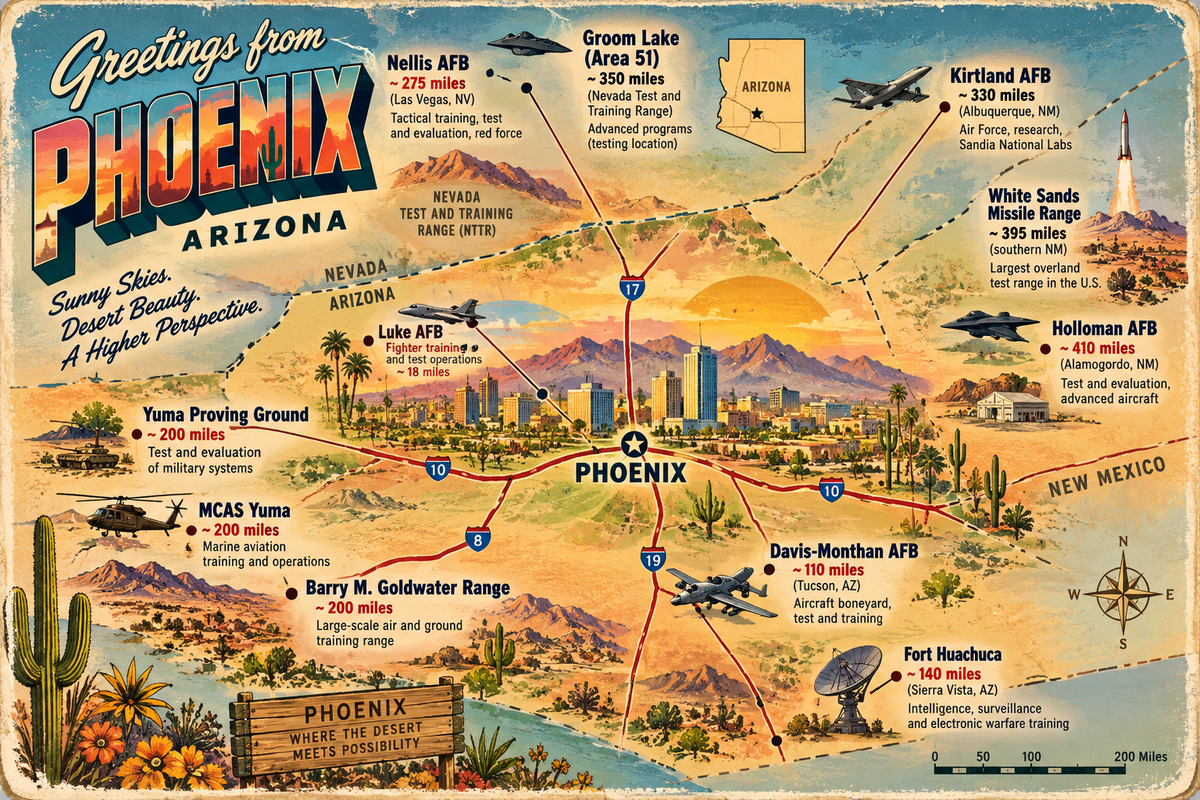
Area 51 sat inside the enormous Nevada military testing complex associated with Nellis Air Force Base, only a few hundred miles northwest of Phoenix. Whatever one believed about aliens, this was genuinely one of the places where the United States tested aircraft the public wasn't supposed to know much about.
That geographical connection gave the emerging Phoenix Lights story unusually fertile ground.
Something strange had appeared in the Arizona sky.
To the northwest lay Nellis and the Nevada test ranges.
Inside that world was Area 51.
And by 1997, Area 51 had become almost synonymous in popular culture with two things at once: secret American aircraft and government concealment of extraterrestrial technology.
The idea that the government might possess extraordinary technology and not tell us about it required very little explanation.
Neither did aliens.
The Phoenix Lights arrived in a culture already supplied with a vocabulary for interpreting them.
But they also arrived in a particular place.
And Phoenix had another vocabulary available.
Phoenix Was an Aviation Town
If you lived in metropolitan Phoenix in 1997, airplanes were not exotic.
Neither was the military.
Neither was aerospace.
Luke Air Force Base operated west of Phoenix.
Williams Air Force Base, southeast of the city, had closed only four years earlier after more than half a century of military pilot training. Its airfield was already being redeveloped for civilian aviation.
Falcon Field in Mesa had begun life during World War II as a military pilot-training field.
And these weren't simply old airfields left over from another era.
In Mesa, McDonnell Douglas Helicopter Systems was building the AH-64 Apache attack helicopter. The Mesa plant was the Apache's only assembly plant. By later in 1997, after McDonnell Douglas merged with Boeing, the facility employed more than 5,000 people and was producing military and commercial helicopters.
In Phoenix, AlliedSignal Aerospace—the descendant of the old Garrett and AiResearch operations—was producing aircraft engines and systems and working on major military aviation programs.
In Scottsdale, Motorola's Government Systems operation worked on military and aerospace electronics.
These were not little shops hidden in industrial parks.
They were major employers.
Around them grew the less famous ecosystem: avionics companies, component manufacturers, maintenance operations, engineers, machinists, flight-test operations, suppliers and contractors whose businesses existed because aviation existed.
And southwest of Phoenix lay the enormous Barry M. Goldwater Range, where military pilots had trained since 1941.
Aviation wasn't something happening somewhere else.
It was part of the local economy.
People worked in it. Their spouses worked in it. Their neighbors worked in it.
Military aircraft were part of the landscape.
That matters.
Because when something enormous and unfamiliar appeared in the sky over Phoenix, some kind of military aircraft was not an absurd conclusion.
It was certainly mine.
I did not look up that night and immediately think extraterrestrials.
I thought I was looking at something military.
I didn't know what.
That was the strange part.
And apparently I wasn't alone.
One contemporary Ahwatukee report compared the approaching formation to the leading edge of a B-2 bomber and considered whether it might be helicopters.
A Prescott witness using binoculars wondered whether the silence could mean some unusual human-built aircraft.
The airline pilot on Interstate 10 believed he was watching several separate airborne objects.
These people weren't necessarily correct.
But their first instinct is historically interesting.
Before the Phoenix Lights became a UFO legend, people underneath them were already trying to identify them as airplanes.
Then There Was the Problem of Size
Everyone remembers how big it was.
I certainly do.
It looked enormous.
It also looked very low.
And very slow.
There was only one problem.
None of us knew how far away it was.
Without distance, size becomes difficult to calculate. So does actual speed. So does altitude.
A relatively small object nearby and an enormous object much farther away can occupy the same amount of sky. An aircraft traveling hundreds of miles per hour at considerable distance can appear to drift slowly across your field of vision.
That doesn't mean witnesses were wrong.
It means we were describing what we could actually see.
And some reports make the problem harder rather than easier.
Witnesses near Prescott estimated the lights at perhaps 1,000 feet. Others described the object in relation to terrain in ways that convinced them it was low. Some Phoenix witnesses believed it passed nearly overhead.
Those observations deserve to remain in the story.
So does the uncertainty.
Because the reported times create a different problem.
If some of the earliest reported times from Paulden and Prescott are treated as exact, the lights would have had to cover substantial distances remarkably quickly.
Yet people underneath them repeatedly described them as moving slowly.
Something doesn't fit.
That doesn't mean somebody lied.
It means eyewitness time estimates, distance estimates and altitude estimates are not instrument readings.
The mystery becomes less tidy.
It also becomes more interesting.
How Fast Was Something That Looked Slow?
Zoom out from one backyard or one freeway.
The reports stretch from northern Arizona through the Phoenix metropolitan area and farther south.
Over that larger distance, the apparently creeping object begins to acquire a perfectly respectable ground speed.
Depending on which witness times are used—and they are not precise—the journey is compatible with speeds that would be entirely unremarkable for an aircraft.
That does not make it an aircraft.
It does something more modest.
It removes one reason that it couldn't have been.
The strange contradiction remains.
From the ground, people saw something that seemed huge, low and almost impossibly slow.
Across the state, something was covering a lot of Arizona.
Both observations belong in the same story.
One Thing or Several?
Then we arrive at perhaps the most interesting disagreement of all.
What exactly were we looking at?
Some witnesses saw lights flying in formation.
Some saw one solid object.
I remember darkness between the lights.
Not ordinary empty sky.
Something that appeared opaque.
Other witnesses were equally convinced that they could see stars between the lights.
The airline pilot who watched from Interstate 10 was adamant that he saw separate objects.
So which witness was right?
Perhaps several aircraft flying in close formation created the impression of one enormous shape.
Perhaps they didn't.
Perhaps it really was a single V-shaped aircraft unlike anything publicly known at the time.
Perhaps different witnesses saw different things.
Thirty years later, certainty is not improved by pretending that the contradictory accounts aren't there.
This is where unknown is allowed to remain unknown.
An Extraordinary Aircraft With an Ordinary Problem
But suppose for a moment that my original instinct was right.
Suppose it was military.
Not an extraterrestrial spacecraft.
Not necessarily five ordinary airplanes flying home from somewhere.
Something unusual.
Perhaps experimental.
Perhaps classified.
Perhaps simply unfamiliar.
That creates another problem.
Why fly it over Phoenix?
Secret aircraft generally work better when thousands of people don't see them.
Flying something spectacular over Prescott, Phoenix and Tucson would seem a remarkably poor way to protect a classified program.
Unless that wasn't the plan.
Aircraft—even extraordinary aircraft—have ordinary problems.
Weather changes.
Systems malfunction.
Routes change.
Flights are aborted.
Pilots divert.
Someone makes a decision that wasn't in the original flight plan.
An extraordinary machine can still have a very mundane bad evening.
And in the Southwest of 1997, an unusual military aircraft would not have been stranded in some technological wilderness.
It would have been surrounded by military bases, training ranges, test facilities and an established aerospace industry.
That doesn't prove anything.
But it makes the possibility less exotic than it sounds today.
What Happened to the Story?
This may be the part of the Phoenix Lights that interests me most now.
I saw something strange.
I interpreted it through the world I knew.
Military aircraft existed.
Secret aircraft existed.
Arizona was full of airplanes.
So I assumed there was probably an airplane involved.
Someone else watching the same lights might have interpreted them through The X-Files, Art Bell, Area 51 and the growing UFO culture of the 1990s.
Neither interpretation changes what was physically in the sky.
But interpretation becomes part of the story almost immediately.
Then the story gets told again.
And again.
The later flare event becomes mixed with the earlier moving lights.
Video of one event illustrates television programs about the other.
Witnesses hear other witnesses.
Descriptions become familiar.
Anniversary stories repeat the most dramatic versions.
The event slowly acquires a canonical shape.
This isn't necessarily dishonesty.
It is what human beings do.
We experience something.
We try to understand it.
Then we tell a story about what happened.
And eventually the story becomes one of the things through which we remember the experience.
What I Actually Remember
I don't remember what errand I was running that night.
I don't remember much about the car.
I remember the lights.
Memory is peculiar that way.
Something extraordinary interrupts an ordinary evening and freezes one part of it while the rest disappears.
What I remember most clearly is the emotional progression.
Alarm.
Curiosity.
Then something surprisingly close to boredom.
Whatever was up there simply kept going.
After fifteen minutes or so, it had done absolutely nothing except continue being strange.
Eventually my route changed.
I lost sight of it.
And I went home.
Nearly thirty years later, we still don't know exactly what traveled across Arizona that night.
We don't know exactly how high it was.
We don't know exactly how large it was.
We don't know whether every witness was looking at precisely the same thing.
And we don't know where its journey began or where it ended.
Perhaps it was something military.
Perhaps my first interpretation was completely wrong.
But put the event back into Arizona in 1997 and that interpretation no longer sounds particularly remarkable.
It sounds like something a person living there might reasonably have thought while looking through the windshield at a very strange sky.
The sky itself supplied no explanation.
It only supplied the lights.
The rest came from us.
And whatever they were, they kept flying south.